
02 October 2025 | 9 minute read
Introduction
I often get asked about particular details regarding neck lift surgery, such as the position and size of the scars, why there can be different scar patterns and about the healing from neck lift surgery. In this article, I’ll walk you through neck lift scars recovery — where scars are placed, how they heal, and best practices for minimizing them.
I, of course, totally appreciate that no-one wants a scar if they can avoid one. Intuitively, it would seem that a shorter scar might be a better scar – more desirable, and easier to hide. Interestingly, however, that is often not the case. The key to an inconspicuous scar, and one that is hard to detect, does not relate to the length of scar, but rather to where it is placed or positioned, and to the quality of the scar. In addition what must be avoided at all costs, is the creation of a contour abnormality such as a lump, bump or puckering which can sometimes result from an effort to make scars shorter than they should be.
The quality of a scar relates to several factors. One we cannot change is an individual’s genetics, their age, and any history of abnormal scarring. However, another key determinant of scar quality is the amount of tension placed on a scar. This is why for all neck lifting and facelifting procedures, one fundamental principle is to avoid pulling the skin tightly. It is the re-positioning of the underlying tissue that creates the change, and the skin is simply a passenger on the deeper tissue that has been lifted, with no tension on it when it is stitched back in place.
What Is a Neck Lift?
A neck lift describes any procedure that addresses contour issues, sagging or fullness in the neck through surgery. There are a variety of neck lifts – some of which can be performed on their own, but many of which are performed in combination with a facelift. This is not only for technical reasons, but also to ensure there is facial harmony after the procedure – no-one wants to appear strange after surgery, and a lifted and rejuvenated neck in the presence of jowls and facial laxity never looks quite right.
Why the Platysma Muscle Matters in Neck Rejuvenation
What most neck lifts have in common is that they target the platysma muscle – the broad, sheet-like muscle that is adhered to the underside of the skin on the front of the neck. This is the muscle that is responsible for the neck bands many people develop, and for the sagging experienced. However, there are other components that contribute to the appearance and function of the neck that might require surgery in order to achieve the best result.
These structures include fat that can sit just under the skin or between the skin and platysma muscle. It can also be “deep” fat, which means it lies beneath the platysma muscle. In some people, the submandibular salivary glands enlarge and begin to drop down. This change can significantly affect both the shape and behaviour of the neck. Other muscles, like the digastric muscles under the mouth, can also enlarge and hang down. This further contributes to the shape and contour of the neck. If these structures aren’t addressed during a neck lift, the final outcome may be compromised.
The Role of Skin Tightening in Neck Lift Procedures
Finally, there is the skin. It is hard to believe, but in some types of neck lift no skin is removed at all. This is often the case in younger patients, where neck volume is reduced by addressing deeper structures. These may include the submandibular salivary glands, deep fat, digastric muscles, and the platysma muscle. The more elastic skin in younger individuals also helps it spring back into place, creating an optimal neck shape.
However, in many patients, and especially when a neck lift is combined with a facelift, then skin will need to be removed. This is routinely done via the scars behind the ears. However, there is one type of less commonly performed neck lifts in which a vertical scar from chin to Adam’s apple is created, known as a direct neck lift. This is typically indicated for older male patients with thin, inelastic excess skin.
Who Makes a Good Candidate for a Neck Lift?
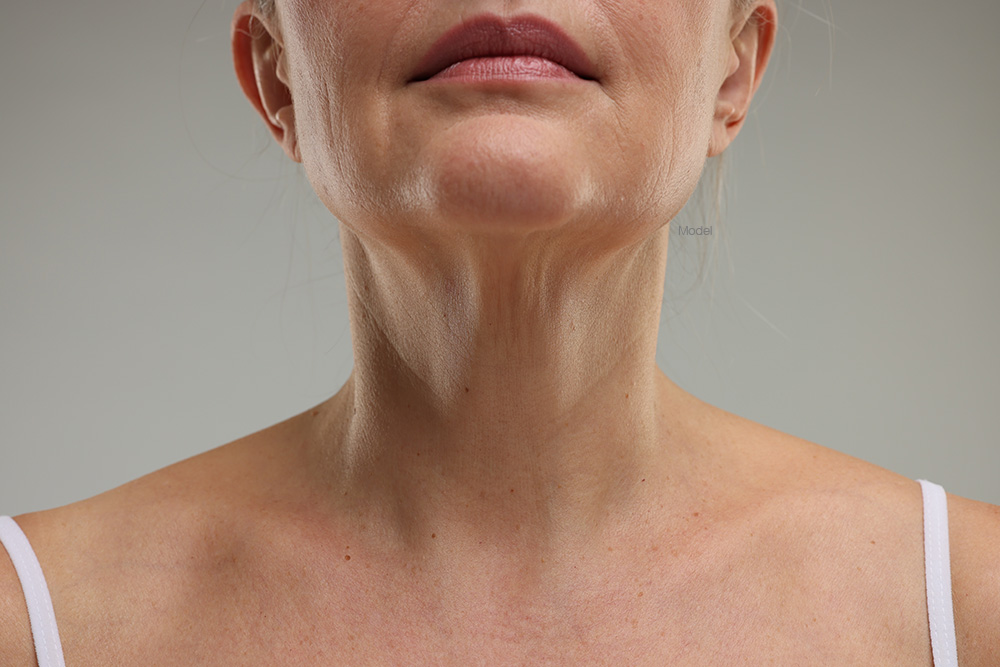
Candidates for neck lifts often have laxity in the area under the chin. Some may be of normal weight but still have excess tissue in this region, often due to genetic or anatomical factors. In some cases, the extra volume is only noticeable when the person tilts their head downward, creating the appearance of a double chin.
Where Are Neck Lift Scars Located?
The scars for a neck lift include a horizontal scar of around 4cm long under the chin. This scar is discreetly located and usually only noticeable if someone looks from a high angle. Even then, once healed, it tends to be fairly inconspicuous. Additional scars are often described as “inverted V” or “inverted U” shapes behind the ears. They run up the crease behind the ear and then back down along the hairline border. Typically, they also follow around the earlobe and weave through the natural folds of the ear, extending up towards the sideburn. The alternative is to perform a direct neck lift as mentioned above, although this is a less common approach.
As mentioned earlier, the key to good scars is not their length, but their placement. It also depends on the absence of tension when the skin is stitched closed. This is why scars from face and neck lifts are usually very good. These procedures follow all the key principles needed for optimal healing.
What Do Neck Lift Scars Look Like?
All scars go through a process known as maturation. This is a natural part of how any scar evolves. Around 6 to 12 weeks after surgery, scars typically enter a phase where they appear pink or red. This happens due to increased blood flow in the area. Over time, the pinkness gradually fades. The goal is for the scars to eventually become fine lines with minimal or no colour, if possible. It takes at least a year for this process, and sometimes it can take up to two years.
Tips for Minimizing Neck Lift Scars
There are different interventions that can improve the process of scar maturation. The simplest, that we always recommend, is massaging of the scars. This helps to soften the scars by physically breaking down the scar tissue, especially the deeper scar tissue. The use of silicone gels or tapes can increase scar hydration. This helps to soften scars and encourages them to fade in colour, reducing their pinkness.
Genetics can play a big role in scar appearance. Some ethnicities and certain skin types have a higher predisposition to developing noticeable scars. This may be because the scars appear darker or because they form as raised, lumpy scars. These include Afro-Caribbean skin types, south Asian and East Asian skin types. Interestingly, red-heads also have a higher risk of developing pink lumpy scars.
With any surgical scar, it is crucial to avoid direct sun exposure until the scar has fully matured. The risk of early exposure is hyper-pigmentation, the laying down of brown colouration on and next to the scar. If it is impossible to cover the scars, then sunblock should be used (and can actually be used to moisturise the scars.
If anyone starts to develop issues or concerns with their scars they should be in contact with the clinic at the earliest opportunity. The sooner we can instigate an appropriate treatment, the better. The next level of treatments includes injections with either steroid or 5-FU. 5-FU was originally developed as a chemotherapy medicine but is now recognised for its excellent anti-scarring properties. Other treatment options may include micro-needling, laser, or similar techniques.
Before & After: Real Results
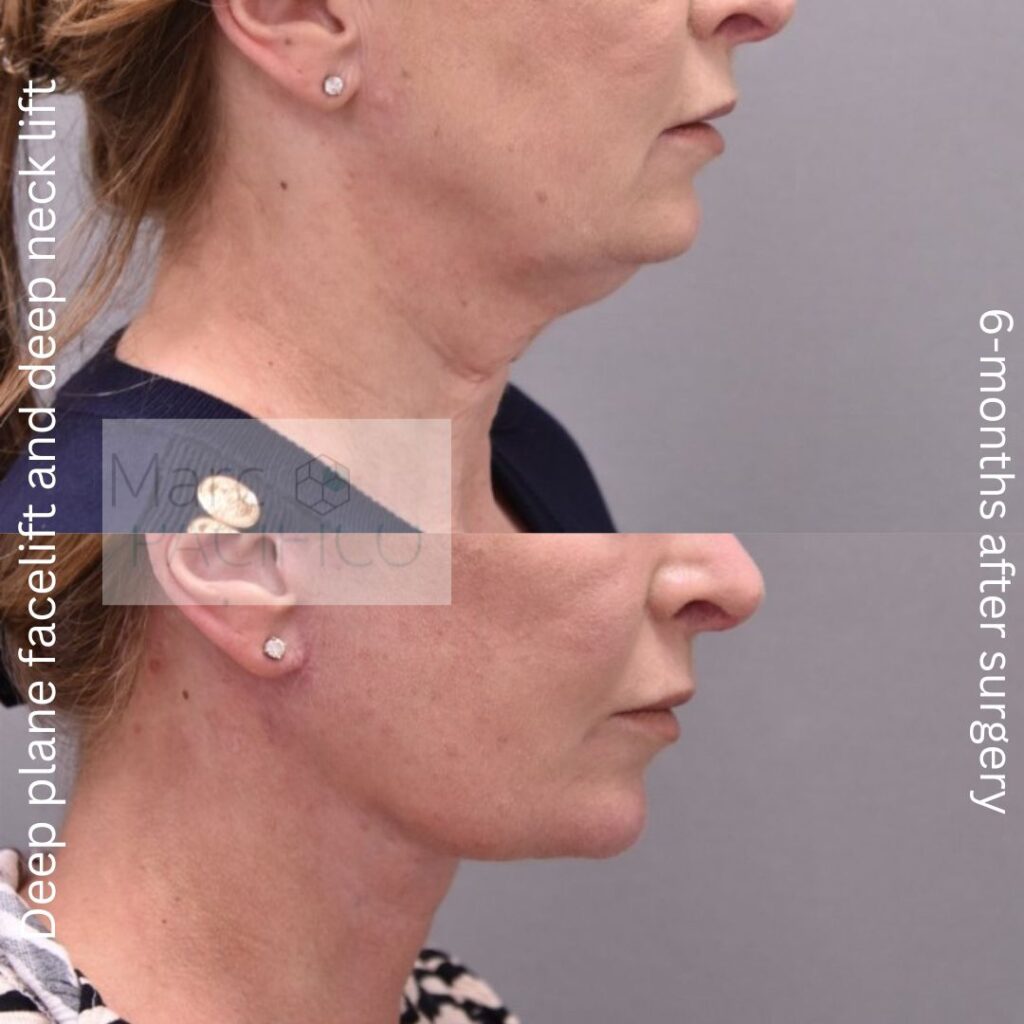
View real patient transformations in the Before & After Gallery.
Frequently Asked Questions
- Do neck lift scars go away completely?
- The reality is that no scar on the skin, anywhere on the body, truly disappears. However, with good scar care and time, many scars can become very faint and hard to detect.
- Are neck lift scars visible with short hair?
- I have performed many face and neck lifts in both men and women with short hair and the scars have been very discreet. As I said earlier, if the key principles of good scar placement and no tension on the closure are applied, then scars should hopefully settle down very well indeed.
- Can I revise old scars from a previous neck lift?
- Old scars, and poor scars can often be improved with surgical scar revision. Depending on the extent of the surgery, this can often be done under local anaesthetic (with you awake).
Why Surgical Technique Matters
It is absolutely key that any neck lifting surgery is performed with meticulous technique and that the appropriate technique is chosen for any given individual. We are all different, and therefore there is no “one size fits all” operation that is suitable for everyone.
If the right technique is applied to the right person, at the right time in their life, then the outcomes can be truly rewarding for my patients, and also for me!
Final Thoughts on Neck Lift Scars
Neck lifting surgery is complex. It requires experience, advanced surgical skill, and a strong surgical team to achieve the best results. With good planning, careful execution, and high-quality aftercare, the outcome can be truly remarkable. Results often look incredibly natural and very discreet.
For more information, please do not hesitate to get in touch with the team at Purity Bridge and we will see how best we can help you – 01892 536 960, info@pacifico.co.uk