29 September 2026 | 8 minute read

Mr Pacifico discusses the importance of managing expectations, understanding your baseline anatomy and aligning post-surgical perspectives to ensure a realistic, satisfying plastic surgery outcome.
Table of Contents
- Will I Still Look Like Myself After Plastic Surgery?
- Will I Remember What I Looked Like Before?
- Why Might I Look at Myself More After Plastic Surgery?
- Getting Used to a Change in Your Appearance
- What Are Realistic Expectations After Plastic Surgery?
- How This Impacts My Approach to the Consultation
- Why Choosing a Plastic Surgeon Is About More Than Before and After Photos
- Arrange a Personalised Plastic Surgery Consultation in Tunbridge Wells
Will I Still Look Like Myself After Plastic Surgery?
One really important topic that, I think, is not discussed enough regarding plastic surgery is your perception of your future self — not only what the result of any potential procedure will look like, but, in a more nuanced way, how you will feel about the result.
If we take my two main areas of interest — the face and the breast — I think there are subtle differences, but actually a lot of overlap. Let me explain what I mean. With respect to face and neck lifting or eyelid surgery, there are two key tenets of any procedure — you ought to look like yourself; and you should not have any telltale stigmata of having undergone a procedure. Seeing friends after your procedure should elicit comments of how well and refreshed you look — not, “What have you had done?”
The reference point for the outcome directly relates to how your face has changed with time and life events, so understanding the appearance of your younger self is crucially important for me.
It takes some time (typically 4–8 weeks) to get to this point during recovery, and for the first few weeks you must appreciate that you will not feel like you look like yourself, and you may feel you don’t recognise yourself in the mirror. It takes a little time to get to the point where you feel that you look like yourself. This is completely normal, and it is key that anyone undergoing facial surgery appreciates this process.
Breast outcomes can be quite different — with genetics, hormones, age, pregnancies, breastfeeding and weight loss (amongst other factors) all impacting on your breasts, your younger breast is unlikely to be a useful reference point (not to mention that, in my experience, not many of my patients have pictures of their younger breasts, whereas they have many of their younger faces!).
The determinants of outcome and the related decision-making have to take into account your goals, of course, but are also intricately bound by your breast anatomy, your tissue quality, nipple position and the likely future behaviour of your breasts over time.
Whether considering surgery to your face or your breast, if these nuanced considerations are reflected on, you are much more likely to have a satisfactory outcome.
Will I Remember What I Looked Like Before?
This question fascinates me — whether it is facial, breast or body surgery, it never fails to surprise me at the post-operative appointments when I show my patients their pre-operative pictures. They are surprised and amazed to see how they used to look. And this can be as early as 4 weeks after surgery! “Did I really used to look like that?” and “It’s like looking at a different person” are two of the comments that I hear on a regular basis.
It is amazing how quickly the brain replaces the old face/body image or memory it had with the new one. So, in my experience, most of my patients will not remember how they used to look — unless you are one of the group that keeps a folder on their phone to refer to every so often to remind themselves!
Why Might I Look at Myself More After Plastic Surgery?
The “guarantee” I talk about with all of my patients before surgery is that they will look at and analyse themselves more after surgery than they ever did before. And this makes sense when you think about it.
If someone comes to see me about a concern that affects their confidence or occupies their mind, they tend to avoid dwelling in front of the mirror and examining that part of their body or face.
However, after surgery, they will analyse, inspect, judge and critique the outcome — especially as it evolves and changes over the first few months. Natural concerns and anxieties over wound healing and swelling further stimulate checking and analysing.
The consequence of this is that they might start to notice things that were there before surgery and are normal for them, but they had never noticed before.
This is why, as part of all of my consultations, I point out specific features of their anatomy, so if they notice it after surgery it does not become “a thing,” and they will not give it a second thought.
Examples I typically point out include asymmetry (the left side of the face is usually dominant and more supportive, with a higher eyebrow and cheekbone; the left breast crease normally sits higher than the right); skin quality and how it behaves (thin “Northern European” skin vs thick “Mediterranean” skin); and chest wall asymmetries that have an impact on how the breasts sit.
A good tip after facial surgery is to look in the mirror only twice a day — when brushing your teeth in the morning and evening. If you look more than this, it risks leading to a spiral of anxiety in the early post-operative period.
Getting Used to a Change in Your Appearance
The length of time it takes to feel like you look like yourself or to feel that your breasts have always been like this does vary. It can be as early as a month after surgery, but in some cases can take several months, and rarely up to a year.
I work closely with Penny Mandich, a psychotherapist, and refer my patients to her before surgery, between our first and second consultations. Having an expert independently talk to you about some of these aspects of what to expect is incredibly useful. She is also there for those who might benefit from her expertise after surgery too — particularly if someone is having a hard time getting used to their new self.
What Are Realistic Expectations After Plastic Surgery?
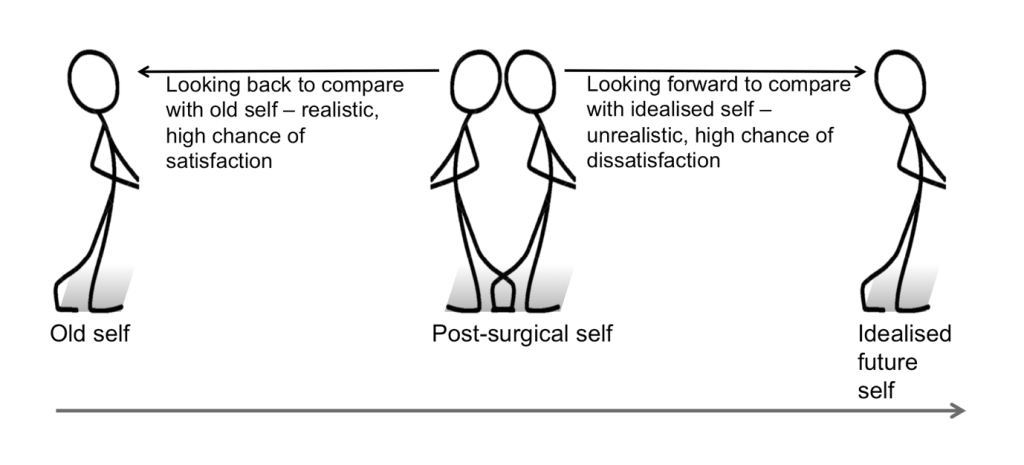
Expectation management is one of the key aspects of the pre-operative process. Understanding your starting position is absolutely key. In my experience, patients who can look back after surgery and compare their result to their pre-operative situation are highly likely to be satisfied — comments such as “Look how much better I am now than before” are really positive.
The patients I have concerns about are those that have an idealised image of their future self. For example, the 40-year-old who has breastfed her 3 children and shows me pictures of 20-year-old pre-pregnancy breasts hoping for that outcome — this, of course, is never possible. I spend extra time with this group of patients to educate them about their starting point, the limitations and the likely outcomes. After all, I can only “work with” the tissues and biology of what is presented to me.
How This Impacts My Approach to the Consultation
To draw all of this together, I think the best way to approach any consultation is to reflect on what it is that is bothering you, understand the impact this is having on your life (such as whether it is affecting your behaviour or stopping you from doing certain things) and then think about what realistically achievable goals you might hope for.
Why Choosing a Plastic Surgeon Is About More Than Before and After Photos
Taking this to a higher level, what you begin to appreciate is that understanding a surgeon’s philosophy, approach to consultations and how they manage patient expectations can be just as important as the results they are able to achieve.
You are putting all your trust in your surgeon. Unlike other big life decisions, such as buying a house or a car, you do not get a guarantee of the outcome. Therefore, being confident that your surgeon understands you, that you are on the same wavelength and that you are both aiming for the same goals (in all aspects) is key. Your relationship with your plastic surgeon may be for many years, and cementing that trust and understanding is key.
I hope these reflections have given you some pause for thought — I have learnt these concepts after talking to and treating thousands of patients over the years, and really getting to understand plastic surgery in a more holistic and bigger picture way.
Arrange a Personalised Plastic Surgery Consultation in Tunbridge Wells
Deciding to undergo plastic surgery is a significant decision that can be made easier with the guidance of an experienced plastic surgeon. Mr Marc Pacifico provides discreet consultations in Tunbridge Wells or Harley Street in London, so you can explore your options in a personalised environment. Call +44 (0) 1892 536 960 or complete the online contact form to get started today.